 العربية
 Do you feel a heaviness in your pelvis or notice your clothes fitting tighter, yet you aren’t gaining weight elsewhere? You might have been diagnosed with a fibroid and are now panicking about the numbers on your ultrasound report. Worrying about which size of fibroid is normal is a common reaction, but you don’t have to navigate this fear alone. Here, we break down the sizes, risks, and how to treat them without surgery.

Which Size of Fibroid Is Normal? (The Short Answer)
When patients ask which size of fibroid is normal, the medical answer is slightly nuanced. Anatomically, a “normal” uterus should not have any fibroids at all. However, because Uterine fibroids are so incredibly common among women of reproductive age, having small, asymptomatic fibroids is often considered “clinically normal” or manageable.
Generally, Smaller fibroids that are less than 1 cm to 5 cm (about the size of a seed to a lime) are frequently viewed as “normal” or harmless if they aren’t causing symptoms. There isn’t a single “cutoff” number where a fibroid switches from normal to abnormal; rather, it is about how the fibroid size impacts your life. A 2 cm fibroid inside the uterine cavity might cause severe bleeding, while a 6 cm fibroid on the outer wall might be completely silent.
In this guide, we will explore the average uterine fibroid size ranges, helping you understand when to watch and wait, and when to seek the expertise of Dr. Samir Abdel Ghaffar for non-surgical catheterization.
Understanding the Muscular Wall of the Uterus and Growth
Fibroids are noncancerous growths that develop in or on the muscular wall of the uterus. They can be singular or multiple, and their growth patterns are unpredictable. Some remain the same size for years, while others grow rapidly.
Understanding the location is just as crucial as the size.
- Subserosal: Grow on the outside.
- Intramural: Grow within the wall.
- Submucosal: Grow inside the cavity (these often cause the most issues even at small sizes).
Hormones like estrogen and progesterone fuel their growth, which is why they often affect women during their reproductive years and may shrink after menopause.
Fibroid Sizes Chart: From Seed to Watermelon
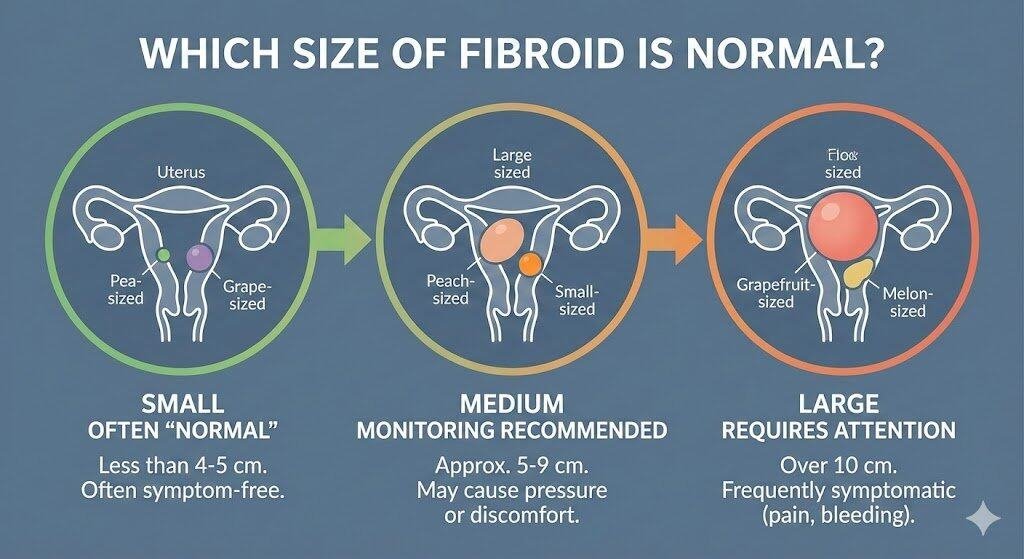
To help you visualize the size of the fibroids, we use fruit analogies. This helps in understanding the medical measurements in centimeters (cm) or millimeters (mm).
- Small (Less than 1 cm to 5 cm):
- 1 cm: Size of a pea or seed.
- 3 cm: Size of a cherry or grape.
- 5 cm: Size of a lime.
- Medium (5 cm to 10 cm):
- 7 cm: Size of a peach.
- 10 cm: Size of a grapefruit or an orange.
- Large (10 cm and above):
- 15 cm +: Can resemble a melon or watermelon.
Large Fibroids Exceed the capacity of the pelvic cavity, often pushing against other organs like the bladder or rectum. If your doctor mentions your fibroid is the size of a grapefruit, it is generally considered significant and likely requires attention, especially if you have symptoms.
When Does Fibroid Size Become Dangerous?
A common question we hear is, “Is my fibroid dangerous?” It is important to know that fibroids are almost always benign (non-cancerous). However, “dangerous” in this context usually refers to complications or severe impact on health.
Which Size of Fibroid Is Dangerous in mm and cm?
There is no specific millimeter count that signals immediate danger. However:
- Over 50 mm (5 cm): This is often the threshold where doctors start discussing treatment options if symptoms exist.
- Over 100 mm (10 cm): These are considered giant fibroids. They can cause heavy bleeding, anemia, and compression of the ureters (kidney tubes), which is a medical urgency.
Impact on Surrounding Organs
As fibroid size increases, the uterus expands. A uterus the size of a 5-month pregnancy (due to fibroids) can press on the bladder, causing frequent urination, or the bowel, causing constipation. This physical bulk can disrupt normal activity, making exercise or even bending over uncomfortable.
Symptoms vs. Size: What Should You Worry About?
While we focus on average uterine fibroid size ranges, the severity of symptoms often dictates the treatment plan more than the ruler measurement.
You could have a massive 10 cm fibroid that grows outward and feel nothing. Conversely, a tiny 2 cm submucosal fibroid can cause:
- Prolonged, heavy menstrual bleeding.
- Passing large clots.
- Severe pelvic pain and cramping.
- Anemia and fatigue.
Therefore, do not just ask “how big is it?” but ask “how is it affecting my health?” If your normal activity is disrupted—you can’t go to work, you’re tired all the time, or you’re in pain—size becomes secondary to the need for relief.
How Fibroids Affect Pregnancy and Fertility
Which size of fibroid is dangerous in pregnancy?
Fibroids can affect fertility and pregnancy, but many women with fibroids have healthy babies.
- Location matters: Fibroids inside the cavity (submucosal) can prevent implantation, acting like a natural IUD.
- Size matters: Large fibroids (>5-6 cm) may compete for space with the baby or cause placental abruption.
- Growth: Pregnancy hormones can cause fibroids to grow rapidly in the first trimester.
If you are planning to conceive, it is crucial to talk to a specialist like Dr. Samir. Treating the fibroid before pregnancy using uterine artery embolization (catheterization) or other methods might be recommended depending on your specific case.
Menopause and the Changing Uterus
Which size of fibroid is dangerous after menopause?
Typically, fibroid symptoms subside after menopause because hormone levels drop, causing the tumors to shrink. However, if a fibroid begins to grow after menopause, this is a red flag.
While rare, rapid growth after menopause can indicate a leiomyosarcoma (cancer). Therefore, any change in fibroid normal size post-menopause requires immediate investigation. A fibroid should not be getting bigger when you are no longer menstruating.
Diagnostic Methods: Measuring the Mass
To determine the exact size of the fibroids, a simple pelvic exam isn’t enough.
- Ultrasound: The first step. It gives a good estimate of size in centimeters.
- MRI (Magnetic Resonance Imaging): The gold standard. It maps the exact location, number, and size of fibroids and distinguishes them from adenomyosis.
Dr. Samir Abdel Ghaffar utilizes precise imaging to plan the Interventional Radiology procedure. By seeing exactly which arteries are feeding the tumors, he can target them effectively irrespective of their size.
The Risks of Leaving Large Fibroids Untreated
Choosing to leave a fibroid untreated (Watchful Waiting) is a valid option for Smaller fibroids with no symptoms. However, ignoring growing or symptomatic fibroids carries risks:
- Severe Anemia: From chronic blood loss.
- Kidney Damage: If a large fibroid presses on the ureter.
- Infertility: As discussed, they can distort the uterus.
- Lifestyle Deterioration: Living with constant pain or bloating.
Why Catheterization (UFE) is the Best Alternative to Surgery
For years, the only answer to “it’s too big” was “let’s take it out” (Hysterectomy or Myomectomy). Today, you have options.
Uterine Fibroid Embolization (UFE), performed by Interventional Radiology Consultants like Dr. Samir Abdel Ghaffar, is a revolutionary procedure.
- No Surgery: No scalpels, no large incisions.
- Preserves the Uterus: You keep your organs.
- Shrinks Fibroids: The doctor inserts a tiny catheter into the artery ensuring blood flow to the fibroid is cut off. The fibroid then shrinks and dies.
- Short Recovery: Return to normal activity much faster than surgery.
Whether your fibroid is the size of a grapefruit or a lime, UFE is effective for multiple fibroids simultaneously.
Frequently Asked Questions (FAQs)
Here, we answer the specific questions you might have about your diagnosis.
Size of fibroid in cm and mm?
Doctors may use both units. 1 cm = 10 mm.
- Small: < 5 cm (< 50 mm)
- Medium: 5–10 cm (50–100 mm)
- Large: > 10 cm (> 100 mm)
Which size of fibroid is dangerous in mm?
There is no dangerous “number,” but fibroids exceeding 50 mm often start causing symptoms. Fibroids larger than 150 mm (15 cm) are significantly large and can mimic a 6-month pregnancy.
Is a 30 mm fibroid big?
No, a 30 mm (3 cm) fibroid is considered small (roughly the size of a strawberry). Unless it is located inside the uterine cavity causing bleeding, it is usually not a cause for alarm.
Is a 4 cm fibroid big?
A 4 cm fibroid is small to medium (size of a walnut or fig). It is very common. Many women have 4 cm fibroids and don’t even know it. However, if it pushes on your bladder, it might feel bigger than it is!
Can fibroids cause coughing?
Rarely, yes. If Large Fibroids Exceed the pelvic brim and grow large enough to press against the diaphragm or lungs, they can restrict breathing or cause a reflex cough. This is a sign of a very large fibroid requiring treatment.
What size fibroids should I worry about?
You should worry about any size that causes:
- Heavy periods soaking through pads in an hour.
- Pelvic pressure that hurts.
- Trouble emptying your bladder.
- Rapid growth (e.g., doubling in size in 6 months).
Fibroid sizes chart?
(Refer to the “From Seed to Watermelon” section above). Keeping a personal chart of your ultrasound results year over year is a good way to track growth.
Conclusion: Take Control of Your Uterine Health
Knowing which size of fibroid is normal is the first step toward empowerment. Whether your fibroids are small seeds or have grown to the size of a grapefruit, you do not have to suffer in silence or rush into removing your uterus.
Dr. Samir Abdel Ghaffar offers a safe, effective, and non-surgical path to reclaiming your life. Uterine Fibroid Embolization treats the root cause, shrinking the fibroids and alleviating symptoms while allowing you to keep your uterus intact. 🌿
Don’t let the numbers on a page scare you. Seek a consultation today to explore if UFE is right for you.
Contact Dr. Samir Abdel Ghaffar:
1. London, UK:
- Clinic number: 00442081442266
- WhatsApp number: 00447377790644
2. Egypt:
- Cairo booking number: 00201000881336
- WhatsApp number: 00201000881336